
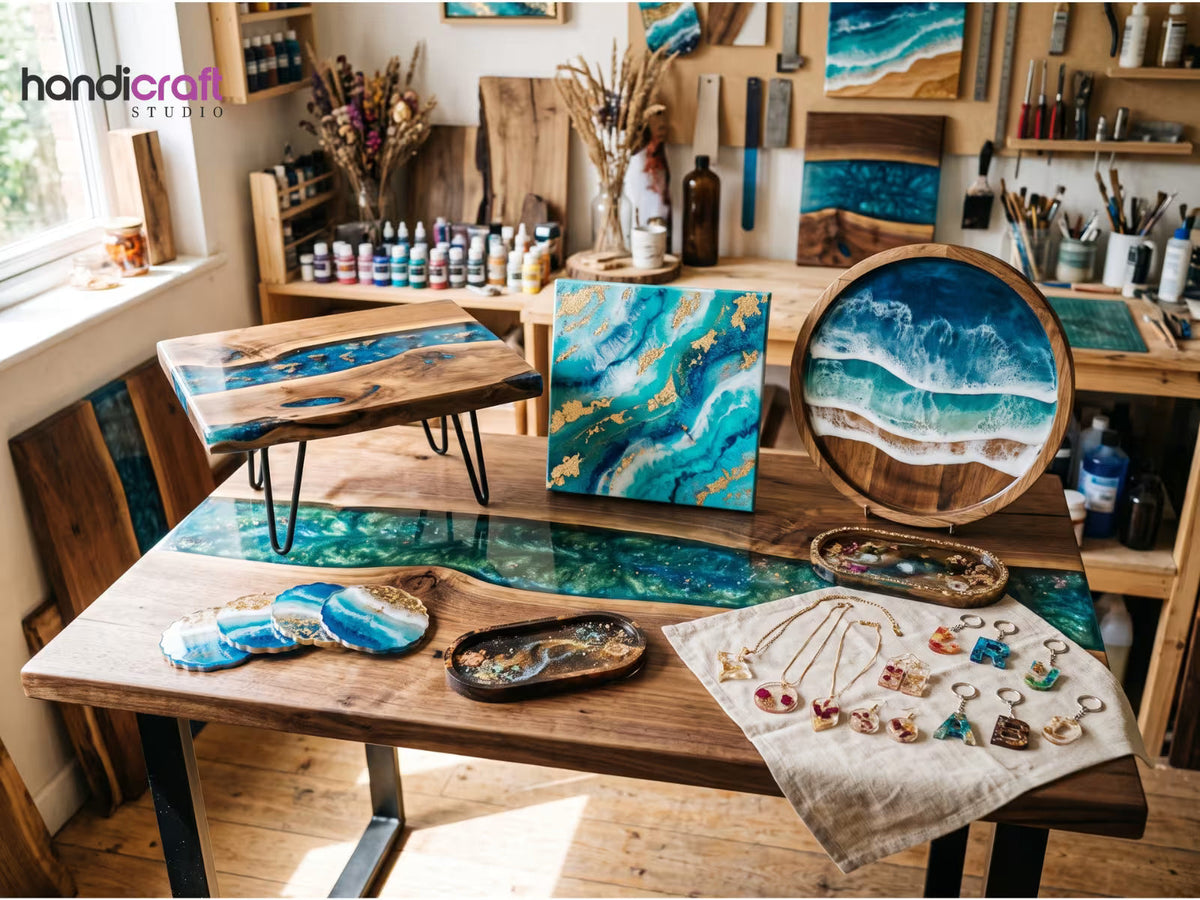
Handmade Epoxy Resin River Tables and Resin Art Decor
Epoxy Resin Art at Home: Matching Epoxy Resin Furniture With Small Resin Home Decor
Epoxy resin art is decor made by pouring a two-part liquid over wood, pigment or dried flowers. The mix then hardens into a clear, glassy solid. At Handicraft Studio, that same material shapes a full range. Our collection holds an epoxy resin table, wall panels, coasters, trays, jewellery and keychains. Every piece is poured by hand here in India.
Prices sit across a wide band. Resin coasters begin near Rs 900 a set. A resin tray or resin wall art panel runs from Rs 2,500 to Rs 12,000. An epoxy resin coffee table starts around Rs 35,000. Large river tops reach Rs 1,50,000, since slab size drives the cost. Most handmade resin gifts stay under Rs 3,000.
Our workshop pairs wood artisans from Himachal and Rajasthan with pourers trained in colour work. So each slab is cut, sanded, poured and polished under one roof. Because the pour is manual, no two pieces match exactly. That small difference is what makes resin home decor feel personal rather than mass produced. Our team photographs each piece before packing.
How Epoxy Resin Art Is Poured and Cured
Two Liquids, One Chemical Cure
Epoxy reaches the bench as two liquids. One is the resin, the other a hardener. Mixed at a fixed ratio, they start a reaction. The batch warms, thickens, then locks solid. This is a cure rather than drying. So nothing evaporates, and the poured depth stays exactly as it was. A deep pour may sit for four to seven days.
Mica Powder, Alcohol Ink and Colour Control
Pigment goes in while the mix is still liquid. Mica powder holds a metallic shimmer and stays suspended, which gives depth from every angle. Alcohol ink behaves differently, because it spreads in fine veins and feathers outward. Our artisans often use both in a single pour.
Full River Pour Versus a Clear Top Coat
A river pour fills a wide channel between two wood edges, often 30 to 50 mm deep. A clear top coat is thin, near 2 to 3 mm, and only seals the face. Therefore the first is structural, while the second is simply a finish.
Epoxy Resin Table Designs That Anchor the Room
An epoxy resin table is normally the heaviest piece in a room. So it sets the colour story, and every smaller item then echoes it. Our range covers dining tops, console tables and a handmade epoxy resin coffee table in several widths.
Live Edge River Table and Epoxy River Table Tops
An epoxy river table keeps the raw bark line of the slab. Tinted resin flows between two halves like water in a channel. Our live edge river table tops run from four to seven feet. Blue, teal, smoke grey and amber remain the favourite pours.
Wood Behind Every Resin Wood Table
We work mostly with acacia, sheesham and mango. Acacia carries a warm, wavy grain. Sheesham is darker and denser, so it suits formal dining rooms. Mango is paler and takes soft pastel pours well. Each slab is kiln dried first, since damp wood spoils a pour.
Epoxy Resin Furniture Beyond Tables
Epoxy resin furniture here also covers window benches, stools and slim console tops. Legs come in black powder-coated steel or in matching wood.
Resin Wall Art and Epoxy Resin Painting Panels
Resin wall art is poured flat on a sealed board rather than brushed on. The liquid keeps moving, so the pattern forms as it settles. Every panel arrives cured, framed where needed, and ready to hang.
Ocean Pour, Geode and Petri Styles
Ocean pour layers deep blues with a white lacing edge that reads like surf. Geode work sets crushed stone, quartz chips and gold leaf into ringed bands. Petri art uses single drops that bloom outward into cell-like flowers. Each finish counts as an epoxy resin painting, though no brush touches it.
Panel Sizes for Resin Artwork
Round panels come in 12, 18 and 24 inch faces. Rectangular resin artwork runs 24 by 36 inches and 30 by 48 inches. Three-panel sets suit a long wall above the sofa.
Resin Coasters, a Resin Tray, Resin Jewellery and Handmade Resin Gifts
Small pieces repeat the colour of the big one. That is how a whole room starts to read as one idea. A teal river top, for example, sits happily beside teal coasters and a matching tray. Because the pours come from related batches, the shades stay close.
Coasters and Trays for Daily Use
Resin coasters arrive in sets of four or six, roughly four inches wide, with cork backing. A resin tray has cast side handles and a wipe-clean face. Both can echo the pour used in your table.
Resin Jewellery and Resin Keychain Pieces
Resin jewellery covers pendants, studs and bangles set with dried flowers or gold flake. A resin keychain holds the same idea at pocket size. Such resin decorative items travel well, so they double as handmade resin gifts for weddings, Diwali and housewarmings.
Choosing an Epoxy Resin Table: Thickness, Timing and Delivery
Slab Thickness and Top Size
Dining tops measure 40 to 45 mm thick. A coffee table sits near 35 mm, while side tables stay around 30 mm. Thicker is steadier, though it also adds weight.
Lead Time and Custom Sizes
A pour cannot be hurried. Tables take three to five weeks from sketch to crate. Small resin home decor ships within seven to ten days. Custom lengths, leg styles and colour blends stay open on request, so share a photo of your room.
UV Stability Against Yellowing
Our table resin carries UV stabilisers, which slow yellowing considerably. Still, no epoxy stays water-clear forever under harsh sun. Placement matters as much as the resin itself.
Packing for Heavy and Fragile Items
Tables travel inside wooden crates with foam edging and corner blocks. Panels and trays ship double boxed. Photographs of the packed piece are shared before dispatch.
Care Tips for Epoxy Resin Furniture and Resin Home Decor
Cleaning Without Scratches
Warm water and mild soap handle almost everything. Wipe with a soft cotton cloth, then dry it. Scouring pads, thinner and acetone will haze the surface, so keep them far away. A light coat of polish twice a year restores gloss.
Heat, Sun and Everyday Habits
Cured epoxy resists heat, yet it is not heatproof. A hot pan placed straight on the top can soften or dull that spot. Therefore use trivets and mats for anything from the stove. Sunlight is the other concern, because long exposure fades pigment and ambers clear areas. Keep an epoxy resin table clear of a west-facing window, or draw a sheer curtain across the afternoon.
Inside the Studio Where Each Resin Artwork Is Poured
Our resin work happens in a dust-controlled room, since one stray fibre spoils a clear pour. First the carpenter squares and levels the slab. Next the mould is built and sealed with tape. Then the pour goes in layers, with each one resting before the next.
A dining top takes roughly 18 working days across pouring, curing and sanding. Sanding alone moves through eight grits before polish. Because temperature shifts the cure, our pourers adjust the mix by season.
Monsoon batches, for instance, rest longer than winter ones. That is also why two river tops cut from one tree never look alike. Grain, colour depth and vein pattern all shift a little.
Common Questions About Epoxy Resin Decor
Is epoxy resin food safe?
Our trays and coasters use a resin rated for incidental food contact. Each piece is also left for a full cure before it leaves the bench. So resting a cup or biscuits on it is fine. Still, please do not cut on the surface or place very hot food directly.
Do resin tables scratch easily?
Cured epoxy is hard, though it is not glass. Keys, ceramic bases and grit can leave fine marks over the years. Most light scratches lift with a resin polish and a soft pad. Deeper ones need wet sanding, which our team handles if the top comes back to us.
Does resin turn yellow over time?
Clear resin can amber slightly as it ages, mostly from ultraviolet light. Our UV-stabilised pour slows that shift by years. Tinted river sections also hide it far better than clear ones. Placement away from strong sun remains the simplest protection you have.
Can I request a custom size or colour?
Yes. Send your length, width and preferred palette, and we match a slab to it. Leg style, edge profile and gloss level are all adjustable. Custom work adds roughly a week to the usual timeline. A sketch is always shared before pouring starts.
How heavy is an epoxy river table?
A six-foot dining top in sheesham with a full pour weighs close to 80 kg without legs. Two people should lift it. Coffee tables run 25 to 35 kg instead. Our crates include lifting handles, so moving day stays manageable.
Is resin decor safe around children?
Fully cured epoxy is inert and gives off no fumes. Panels and tables are therefore fine in family rooms. Small resin jewellery and keychain pieces are another matter, because tiny parts suit older children only. Edges on trays are rounded during finishing for that reason.